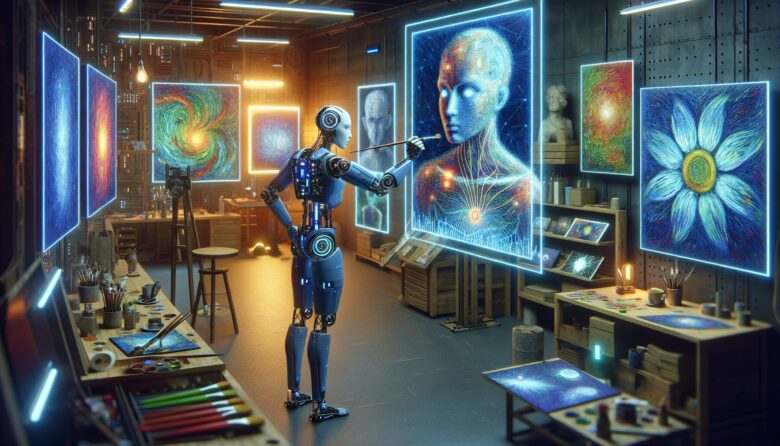
Hey fellow tech enthusiasts! Today, we’re diving into a topic that’s been rattling around my brain and getting me genuinely excited: the growing role of artificial intelligence in the creative arts. Imagine a world where your co-songwriter, painting buddy, or even collaborator on your next novel isn’t human, but rather a super-smart algorithm. Sound intriguing? Let’s pull at this thread a bit and see what unravels.
The Rise of the AI Artist
I recently stumbled across a digital painting that mesmerized me. The colors danced in a way that felt both vividly real and surreal, a contradiction that caught me off guard. When I read the byline, I realized it wasn’t by a human artist but by a neural network cleverly named “ARTBOT3000” (kudos for the creative name!). My first thought was, “Whoa, AI isn’t just solving problems anymore; it’s making art!”
AI-created art isn’t just a novelty anymore. Companies like OpenAI and DeepArt are experimenting with all kinds of cool algorithms that can generate creative content. OpenAI’s DALL-E can whip up detailed illustrations from textual descriptions in a way that feels almost magical. This tech is now powerful enough to simulate human artistry, leading us to ask, “What does it mean to be an artist?”
Algorithms with a Splash of Human Touch
AI art doesn’t strip the human element away entirely. Most AI art tools still need a human touch to guide or refine final outputs. Think about a DJ mixing tracks; the creativity lies in that combination. With AI, humans are setting boundaries, defining parameters, and adding their unique spice.
Have you ever played with a tool like Google’s Magenta? It’s a perfect example of AI working hand-in-hand with musicians to generate new compositions. The AI creates possibilities, and the musician picks the gems from the generated chaos to craft something truly fantastic. It’s more of a dance than a takeover.
Bridging Gaps: From Concept to Masterpiece
One killer app of AI in the arts is how it could democratize creativity. With these tools, you don’t need years of training to produce compelling creations. This shift challenges the status quo, breaking down barriers to entry in creative fields.
Remember when Netflix announced an AI-written movie script? It wasn’t a masterpiece, but it opened the door to endless possibilities for scriptwriters. Startups are now sprouting up, exploring everything from AI-assisted songwriting to AI-generated film scoring. With the cost of creation plummeting, more voices can enter and enrich the creative marketplace.
Challenges and Ethical Considerations
Of course, it can’t all be roses and sunshine. There’s the ever-present looming question of ethics. Who gets credit for an AI-generated piece? Can an algorithm truly “create”?
Some fear this tech might steal jobs in these creative industries. After all, why hire a pricey composer when an AI can churn out symphonies at a fraction of the cost? Yet, I think there’s room for harmony here. AI could handle repetitive tasks, freeing up human creatives for more complex, visionary work.
Then there’s the artistic identity crisis facing creators. If machines can mimic or even surpass human creativity, what’s our unique value proposition? Do we need to rethink what it means to be creative, or rather, who gets to claim that creativity for themselves?
The Future: Humans and AI, Co-Creators of Tomorrow
So what’s next? I envision a future where AI becomes an invaluable sidekick in the artist’s toolkit, a sophisticated brush or a complex musical instrument. Far from replacing human touch, it’ll augment our abilities, much like how the camera transformed traditional painting.
Picture this: collaborative theaters where human actors perform alongside virtual AI characters offering real-time interaction based on audience feedback. Pretty wild, huh? This isn’t just science fiction anymore; it’s knocking at our door.
In this coming age, artists and AI can create a partnership where each complements the other’s strengths. Perhaps one day, creativity will no longer be a singular trait but a shared experience, woven together from human and machine-produced wonders.
Let’s keep this conversation going. What are your thoughts on AI in the arts? Are we heading towards a creative renaissance, or is it Pandora’s box cracked open? Let’s chat in the comments, and until next time, keep dreaming, creating, and coding. Here’s to whatever weird and wonderful things come next!