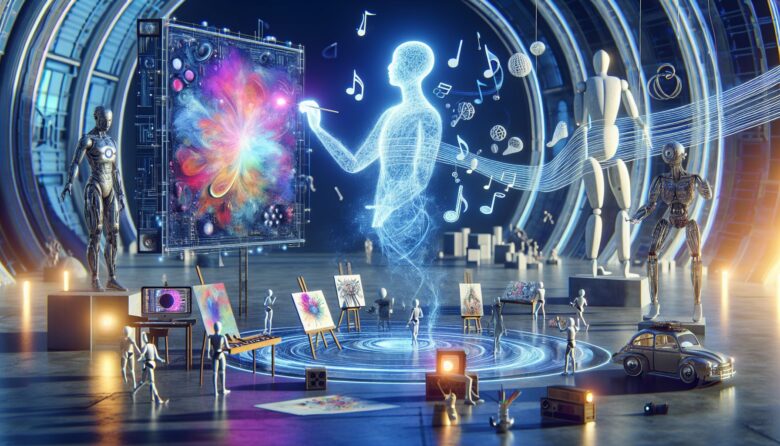
Hey, tech enthusiasts! Today we’re diving into something that’s both exciting and a bit mind-blowing—Artificial Intelligence in the creative arts. We’re talking about where algorithms meet artistry, and honestly, machines are getting scary good at mimicking human creativity. It’s happening faster than any of us expected. Grab a coffee, kick back, and let’s geek out over how AI is becoming the latest muse for artists around the world.
AI: The New Renaissance Artist?
Let me start by saying that when I first heard about AI being used to create art, I was a bit skeptical. How could a bunch of code seriously compete with human creativity? But I have to admit, seeing is believing. From AI-generated paintings that sell at prestigious auction houses, to music tracks that could easily top charts, AI’s place in art is getting pretty real.
So, What is AI Art?
For those who might not be in the loop, AI art is artwork created with the help of artificial intelligence algorithms. This isn’t just limited to visual arts. It covers music, literature, and even film. One of the most famous examples is the painting “Portrait of Edmond de Belamy,” which was auctioned off for a cool $432,500. The kicker? It was created by an algorithm developed by the Paris-based collective, Obvious.
How Does It Work?
You might be wondering how exactly AI creates art. The magic lies in a type of machine learning called Generative Adversarial Networks, or GANs. Without getting too technical, think of it as two neural networks trained to compete against each other. One creates new content while the other critiques it. This continuous feedback loop refines the quality of the output until it becomes something that can genuinely pass as “art.”
Breaking Down Barriers in Music
Music production is another realm where AI is making big waves. Remember the days when creating original scores required a full-blown studio? Today, with platforms like Amper Music and OpenAI’s MuseNet, anyone can generate original compositions in almost any style you can dream of.
AI as a Band Member
Some musicians are embracing AI as a sort of band member who never shows up late to rehearsal. Take Taryn Southern, for instance, who created an entire album, “I AM AI,” with the help of AI tools. AI can analyze a massive database of musical compositions, which lets it create melodies and harmonies that work as inspiration or even fully realized tracks.
Changing the Music Landscape
But this isn’t just about ease or speed. AI encourages creativity by challenging traditional norms. It’s a weird contradiction when you think about it. Sure, skeptics argue that AI might dilute the authenticity of human emotion in music, but others see it as evolution. After all, what’s more authentic than expanding the boundaries of what’s possible?
The Literary Genius of AI
If you’ve ever read a poem and thought, “I could write that,” well, now so can AI. Thanks to advancements in natural language processing, AI can generate text that rivals the works of seasoned authors. GPT-3, anyone?
The Case of Botnik Studios
Here’s a fun example: Botnik Studios, a community of writers, artists, and developers, used AI to co-write new chapters of the Harry Potter series, complete with hilarious twists and turns. OK, maybe it wasn’t entirely coherent, but it definitely sparked conversations about AI’s capabilities in storytelling.
The Implications for Writers
This development raises some interesting questions for the future of writing. Will writers become more of “AI operators,” guiding machine-generated content? I doubt we’ll be replacing authors anytime soon. The human touch is irreplaceable. But it certainly opens new avenues for collaborative storytelling.
Challenges and Ethical Dilemmas
Of course, it’s not all rainbows and roses. The rise of AI in creative fields also brings up some important debates. For instance, who owns the copyright to a piece of AI-generated art? The human behind the algorithm, or the algorithm itself? It’s an ongoing debate about creativity and originality.
The Danger of Automation
Let’s not forget the ever-looming fear: automation. If machines can create art, music, and literature as efficiently as humans (or more so), what does this mean for artists? Will creativity become a niche space reserved for the ultra-elite while AI generates commercial content? Definitely something to think about.
What Does the Future Hold?
So what’s next? While it’s hard to predict, I’m betting that AI will become an even more important tool across all creative fields. We might see entirely new art forms born from this collaboration of man and machine, giving philosophers and tech gurus plenty to argue about.
An Exciting Mix of Man and Machine
Maybe I’m a bit of a techno-utopian, but I believe that AI won’t replace human creativity. It’ll enhance it. Much like the invention of the camera didn’t eliminate painting, AI will just add another dimension to creative expression.
For the Love of Progress
We’re at the edge of what could very well be a new Renaissance era. I, for one, can’t wait to see how artists continue to use AI to push the boundaries of imagination. Let’s keep our minds open and our eyes peeled for the next masterpiece, crafted by this wild combination of silicon and neurons.
That’s a wrap for today. Stay curious, friends, and remember: the future is what we make it.