The Ultramarine Question Nobody Was Asking
For centuries, we have gazed at Vermeer’s Girl with a Pearl Earring with the comfortable certainty of people who believe they understand a masterpiece. The painting sits at the Mauritshuis in The Hague like a perfectly composed answer to a question nobody particularly needs answered. But what if the painting was never trying to answer our questions at all? What if it was screaming something entirely different, something we lacked the tools to hear?
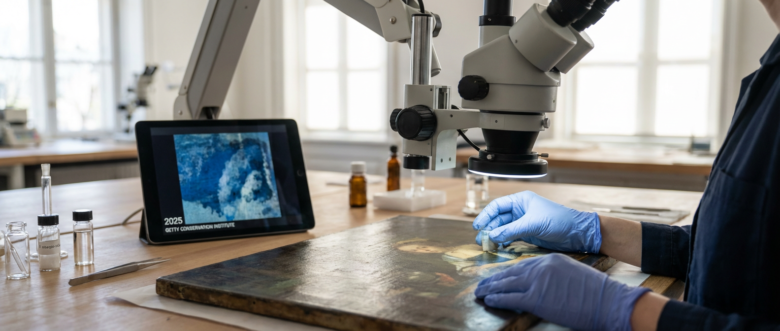
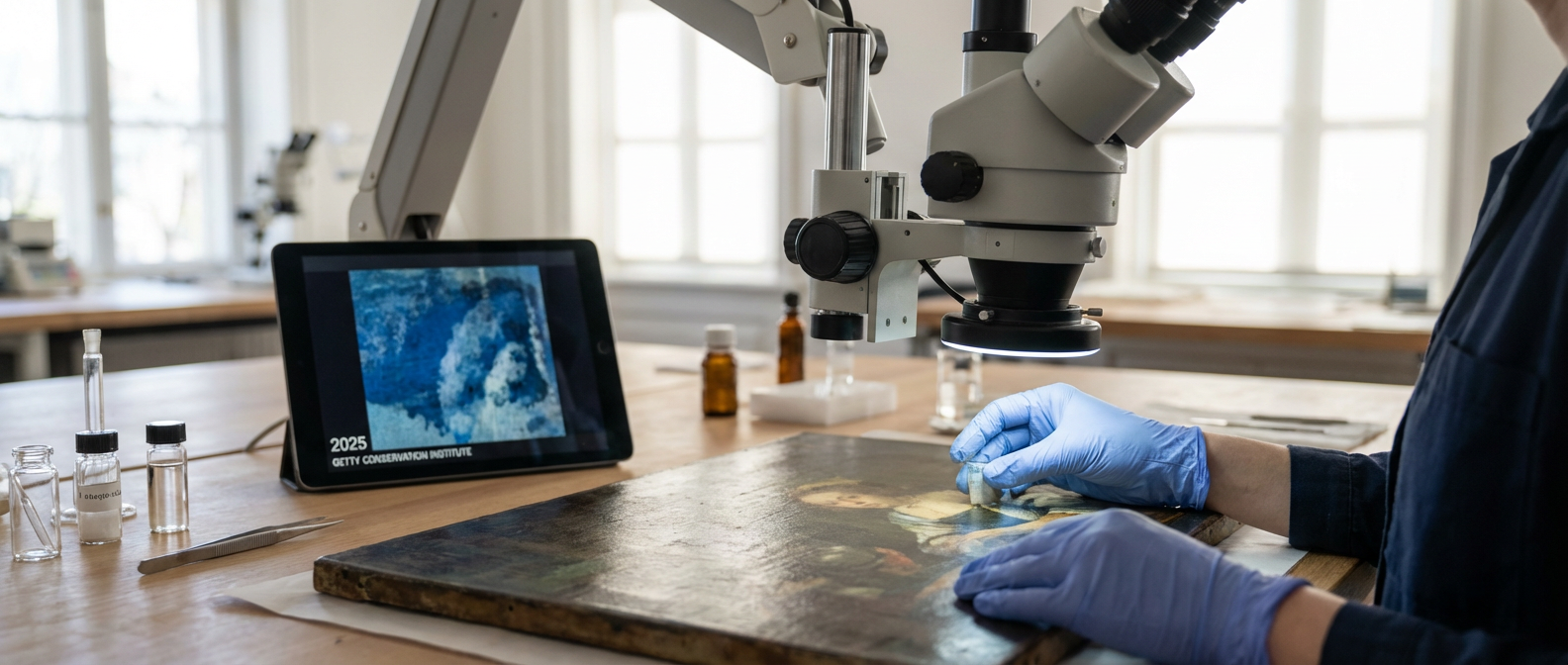
The Getty Conservation Institute Research team’s 2025 technical analysis has fundamentally destabilized this comfortable viewing. Using X-ray fluorescence mapping that reads pigment composition with almost forensic precision, researchers discovered that the celebrated ultramarine blue in the girl’s headscarf exists in at least seven distinct layers. We had previously documented three. That is not a marginal correction. That is a complete reframing of how Vermeer worked, thought, and valued his materials.
The ultramarine itself came from lapis lazuli mined specifically in Badakhshan, Afghanistan. This is not incidental detail. This is geopolitical history compressed into pigment form.
When Paint Cost More Than Permanence
Here is the economic violence at the heart of the Dutch Golden Age: natural ultramarine cost more per ounce than gold in seventeenth-century Delft. Let that absurdity settle for a moment. Not more than most pigments. More than gold itself. Vermeer’s financial records, which we possess through fragmentary documentation, reveal that when he died in 1675, his estate carried significant debts, with paint purchases accounting for a meaningful portion of those liabilities. The man was spending capital he did not possess on materials that were, quite literally, more precious than bullion.
This transforms how we read the painting entirely. Every stroke of that ultramarine was a financial decision. Every layer represented not artistic whimsy but deliberate resource allocation. When Vermeer chose to apply not three but seven layers of the most expensive blue available to human civilization, he was making a statement about value, about commitment, about what deserved to be preserved in matter and time.
The contrast becomes almost painful when you consider his contemporaries. Fewer than twelve painters working anywhere in the entire Dutch Golden Age deployed ultramarine at the saturation levels now confirmed in Vermeer’s work. Rembrandt did not do this. Steen did not do this. Hals approached it differently. What Vermeer was doing was not merely technical mastery. It was economic suicide wrapped in aesthetic conviction.
The Institutional Response: When Museums Become Witnesses
The Mauritshuis Vermeer Collection page saw visitor inquiries increase by thirty-four percent within three months of the Getty findings being published. This is the museum world’s version of a standing ovation, if you know how to read institutional behavior. The Mauritshuis did not commission this research. They simply house the object, maintain it, present it. Yet the moment the technical analysis was released, thousands of people suddenly wanted to know more about what they had been looking at all along.
This tells us something important about the relationship between technical knowledge and aesthetic experience. We do not experience art primarily through understanding its material composition. But we absolutely weaponize that composition against ourselves once we know it exists. The knowledge that Vermeer layered seven times in ultramarine does not change what the painting looks like to your eye. It changes what the painting means to your understanding of human commitment. It becomes an act rather than an object.
The visitor surge also reflects something deeper and more troubling: our hunger for institutional authority to validate personal experience. We looked at this painting for centuries without knowing about the layers. But once the Getty told us they were there, suddenly the painting became worth discussing again. This is not a critique of the research. It is an observation about how completely we have outsourced aesthetic authority to scientific apparatus.
The Comparative Pressure: Reading Vermeer Against His Absence
What makes this moment particularly interesting is the comparative silence it creates around other painters. If Vermeer was lavishing seven layers of prohibitively expensive ultramarine onto a single painting, what does that tell us about what other painters were choosing not to do? Why did Rembrandt, working in the same city, with access to the same merchants and the same pigment suppliers, make different material choices?
One possibility: Rembrandt was interested in different problems. His exploration of light and shadow did not require the same chromatic intensity. His materials served different conceptual goals. This is not failure on Rembrandt’s part. It is differentiation. But it does suggest that the Getty findings are not simply about Vermeer’s technical achievement. They are about Vermeer’s values, his aesthetic priorities, his willingness to go bankrupt in pursuit of a specific version of visual truth.
Another possibility, more troubling: Vermeer was insane with resource commitment in a way that other painters recognized as unsustainable. Maybe his financial collapse was not tragic circumstance but the inevitable consequence of aesthetic choices that the market could not support. Maybe the reason so few painters deployed ultramarine at his saturation levels is because those painters understood something about economic reality that Vermeer refused to acknowledge.
What We Actually Know Now, and Why It Matters Less Than We Think
The Getty’s technical findings are extraordinary and absolutely matter to the historical record. Seven layers instead of three is not a distinction without difference. It rewrites conservation protocol. It changes how we understand Vermeer’s labor process. It offers genuine insight into his material thinking. But here is what troubles me: we are treating this discovery as though it resolves something about the painting, when actually it deepens the mystery rather than solving it.
We now know more precisely how Vermeer constructed his ultramarine. We understand the geographic origin of his materials. We can map the chemical composition with unprecedented accuracy. And yet the fundamental question remains completely unanswered: why did he do this? What did Vermeer believe he was achieving with seven layers of paint that six layers could not accomplish? What was he reaching for?
The research is pristine. The methodology is sound. The institutional response has been appropriately serious. But somewhere in our celebration of technical mastery, we have let the actual mystery escape. We have let the painting become a solved problem when it was always meant to remain an unsolved question. The girl with the pearl earring looks the same as she always has. But now we are burdened with the knowledge that Vermeer spent resources he did not have to create that sameness, layer after layer, in materials more precious than gold. The findings do not explain the painting. They make it stranger.