
When a Film Demands to Be Reckoned With
Brady Corbet’s “The Brutalist” claimed the Academy Award for Best Picture on March 2, 2025, and it didn’t just win a statuette. It won the right to be endlessly debated, deconstructed, and defended across every corner of the cultural conversation. Adrien Brody took home Best Actor. Corbet himself secured Best Director. The film arrived at the ceremony’s conclusion like an architectural monument demanding entrance: three hours and thirty-five minutes of deliberately paced, unapologetically ambitious cinema that refuses to be mistaken for anything less than an event.

This wasn’t the inevitable coronation of a crowd-pleaser. The Academy essentially announced it had chosen confrontation over consensus. Corbet’s vision, shot in VistaVision, that gloriously anachronistic widescreen format that last dominated cinema in the 1960s, represents everything contemporary Hollywood allegedly fears: length, patience, opacity, and an absolute refusal to compromise its formal ambitions for commercial viability. Yet here we are, watching the institution reward exactly that intransigence.
The Box Office Doesn’t Lie, and Neither Does This Discomfort
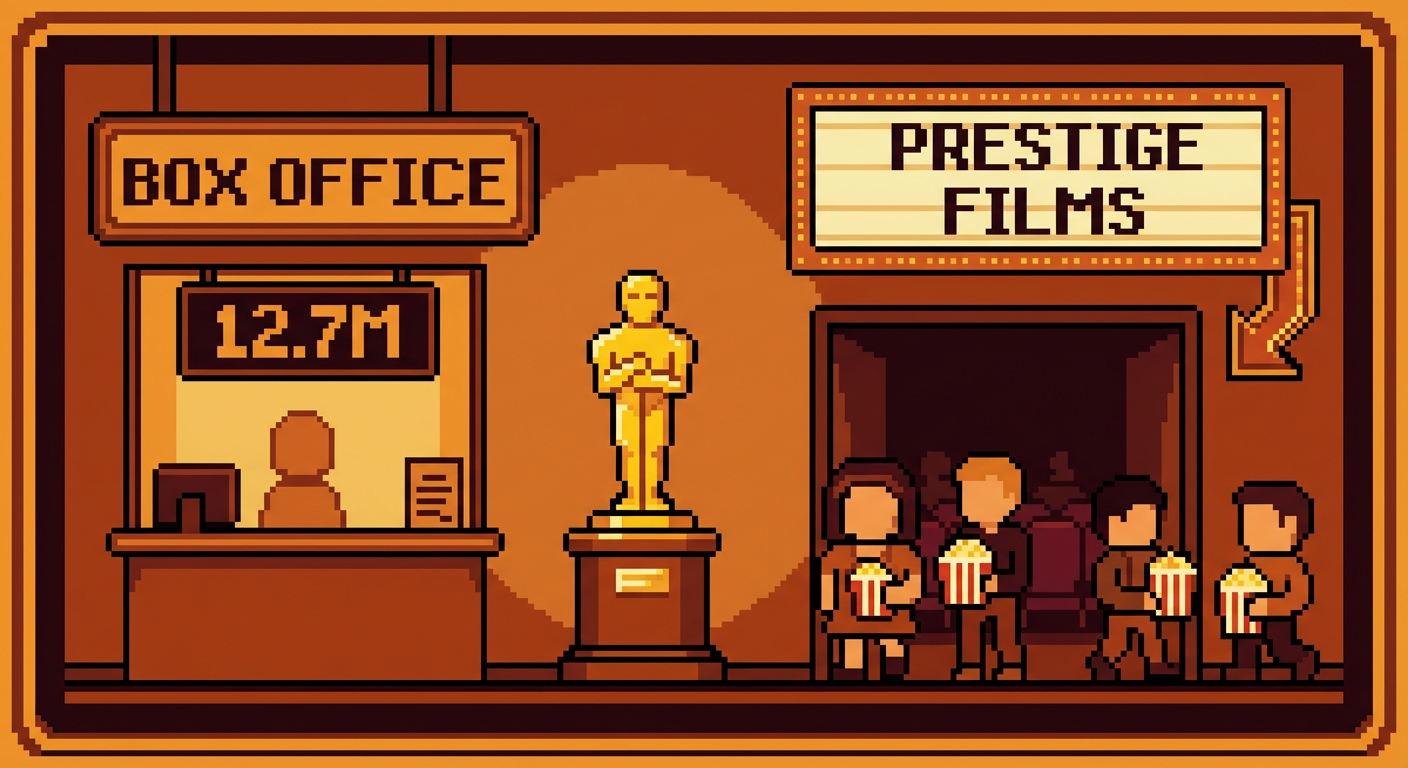
Let’s address the elephant in the room that nobody wants to discuss at the afterparty: “The Brutalist” earned approximately $12.7 million at the domestic box office before its Oscar victory. That figure sits comfortably among the lowest theatrical grosses for any Best Picture winner in recent memory. In an era when prestige filmmaking is already fighting for screen time and audience attention, when streaming has fundamentally altered how people consume cinema, when the theatrical experience has become something reserved for spectacle and franchise comfort food, Corbet’s film arrived and asked audiences to sit in silence for over three and a half hours. Most people declined.
This creates a fascinating paradox worth examining without sentimentality. The Academy rewarded a film that the American moviegoing public largely ignored. That’s not a critique of either party. It’s an observation about the current state of cinema itself. The victory feels both celebratory and elegiac, as though the institution is making a statement not about what audiences want, but about what cinema could still be if anyone bothered to show up.
The AI Question That Nobody Wanted to Answer
Then came the controversy that transformed the conversation entirely. In early 2025, as the film ascended toward Oscar glory, revelations emerged about the use of artificial intelligence in post-production. Specifically, AI tools had been deployed to subtly modify and standardize the Hungarian-language dialogue spoken by Adrien Brody and Felicity Jones, adjusting accents for consistency and clarity. This wasn’t a superficial detail. This was a technical intervention directly impacting the performances of two lead actors in a film celebrating immigrant experience and cultural displacement.
The response was immediate and fractious. Industry insiders, craft professionals, and theorists all mobilized around fundamental questions: Does AI-assisted sound design constitute a violation of an actor’s performance? What happens when technological intervention targets the voice itself, that most intimate and irreplaceable aspect of an actor’s instrument? Where exactly is the line between acceptable post-production enhancement and something that demands explicit disclosure and consent? The debate revealed genuine fault lines within the film world between those who viewed the technology as a pragmatic tool and those who experienced it as a form of erasure.
What Brutalism Actually Means Here
The architectural criticism emerging from publications like Architectural Record Film Review and Dezeen offered a different avenue for interrogation altogether. These observers praised Corbet’s visual understanding of Brutalist aesthetics, his genuine architectural literacy, the way the film’s compositions honor and interrogate the movement’s forms. Yet simultaneously, they questioned the film’s characterization of its own subject matter. How does the film represent Hungarian Jewish immigrant identity in post-war America? What narrative does it construct around mid-century patronage culture and artistic compromise? These aren’t idle scholarly quibbles. They’re questions about whose story gets told when cinema claims historical authenticity.
The film becomes genuinely complicated when you hold all these observations simultaneously. Technically sophisticated yet ethically troubling. Visually magnificent yet narratively contested. A genuine artistic achievement and, at the same time, a film that struggled to find an audience willing to engage with its ambitions in real time.
The Victory and What It Actually Means
So what does Corbet’s win signify? It’s tempting to interpret it as validation of artistic integrity over commercial calculation. It’s equally tempting to read it as institutional nostalgia, the Academy rewarding a film that looks backward toward cinema’s golden age of VistaVision spectacle, perhaps unaware of how its own technological compromises undermine that very nostalgia. You can check the Academy Awards Official Results and find the facts, but the facts don’t resolve the tensions.
What matters is that this win opens rather than closes debate. It suggests that prestige cinema still has advocates in institutional spaces, that length and difficulty haven’t been entirely sacrificed to algorithmic recommendation and streaming optimization. It also forces us to reckon with questions about labor, technology, representation, and what we’re actually celebrating when we celebrate films. The argument isn’t diminishing the film’s achievement. It’s deepening it. That’s precisely where the most interesting conversations happen.