
The Scale of the Spectacle
MoMA has mounted something genuinely staggering this season: over two hundred works by Jean-Michel Basquiat, spanning from his earliest tag-heavy street interventions to the monumental canvases of his final years. This is not a modest survey. This is a statement of institutional conviction, or perhaps institutional necessity. When a museum dedicates that much wall space, that much curatorial labor, that much risk to a single artist, the question worth asking is not whether the work deserves scrutiny, but what the retrospective reveals about how we value artists and how institutions navigate that valuation in real time.
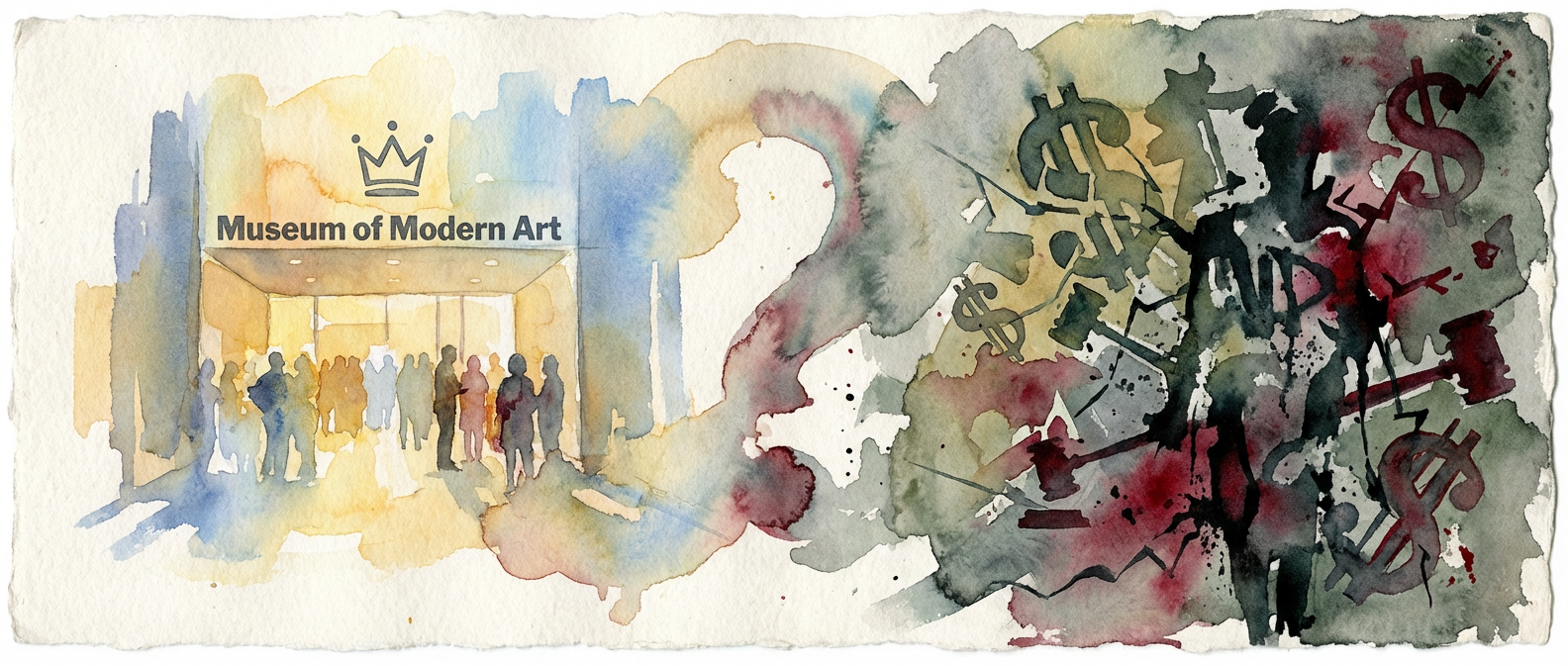
The ambition here is hard to overstate. Previous Basquiat exhibitions have tended toward the thematic or the chronological-lite. This one sprawls across decades, mediums, and conceptual territories with the kind of comprehensiveness that only a major institution can attempt. MoMA’s own attendance metrics bear this out: record visitor figures last year exceeded three point two million, with blockbuster retrospectives accounting for roughly forty percent of those surges. The public hunger for Basquiat remains ravenous, even decades after his death in 1988.

The Authentication Problem and Its Ghosts
Before we can even discuss whether this retrospective represents a triumph or a capitulation to market forces, we have to reckon with a fundamental institutional scar. The Jean-Michel Basquiat Authentication Committee, which once was the arbiter of what counted as legitimate Basquiat, dissolved in 2012 amid allegations of gatekeeping and improper authentication practices. The fallout continued: in 2022, the Supreme Court of New York issued a ruling that effectively acknowledged the committee’s questionable oversight and cast doubt retroactively on its determinations. This is the context in which MoMA has assembled this exhibition. The curators are working in a landscape where the very foundation of attribution has been destabilized.
What does it mean for MoMA to present Basquiat’s work with such categorical certainty when the art world itself has been forced to reckon with the problem of knowing what is and is not authentically Basquiat? The answer is worth sitting with: it means that the institution, by virtue of its legitimacy and scholarly apparatus, becomes the guarantor of authenticity in a way that the failed committee could not. This is not conspiratorial. It is simply how institutional authority functions. MoMA’s curation becomes, in effect, a kind of authentication. The retrospective does not merely display Basquiat’s work; it authorizes it.
The Market Oxygen
Now let us speak directly about the financial machinery. In 2017, Basquiat’s monumental 1982 painting titled simply “Untitled” fetched one hundred ten point five million dollars at Sotheby’s, setting the record for an American artist at auction that still stands today. That single sale should tell you everything you need to know about how thoroughly Basquiat has been absorbed into the contemporary art market’s upper atmosphere. He is no longer a difficult artist. He is a safe bet. He is blue-chip.
Which brings us to the uncomfortable observation that market analysts at ArtTactic Art Market Reports have been tracking: Basquiat’s secondary market sales increased by twenty-two percent year-over-year in 2025 alone. Is the retrospective driving this, or merely coinciding with it? Probably both, which is precisely where cynicism settles in for many observers. There is a reasonable argument that institutional exhibitions and speculative collecting have become locked in a feedback loop, each justifying and amplifying the other. When a collector sees a work entering the MoMA show, does that increase its perceived value? Of course it does. Does MoMA know this? Of course it does.
Why This Matters More Than the Cynicism
And yet. To dismiss this retrospective as merely a posthumous cash grab because market forces swirl around it is to mistake the symptom for the disease. The real question is whether the exhibition itself adds meaningful knowledge to how we understand Basquiat’s artistic project. Does it recontextualize his work? Does it recover suppressed histories? Does it challenge prevailing interpretations? On these questions, the early assessments suggest that yes, it does.
The retrospective’s curatorial approach appears to foreground Basquiat’s engagement with art historical canon, his deliberate negotiations with high modernism, and his linguistic playfulness in ways that earlier presentations sometimes subordinated to biographical or market narratives. By organizing the work thematically rather than purely chronologically, MoMA has created space for viewers to recognize patterns of intellectual ambition that might otherwise get lost. This is what a well-conceived retrospective can do: it does not merely affirm the artist’s importance; it refines and deepens our understanding of what that importance actually consists of.
The Institutional Contradiction
The unsettling truth is that MoMA can simultaneously be running a genuine scholarly operation and participating in market amplification. These are not mutually exclusive. An institution can be genuinely committed to understanding an artist’s legacy while also benefiting materially and symbolically from the attention that exhibition generates. The retrospective is both a cash grab and a triumph, which is to say it is a properly complicated thing. It is what happens when scholarly ambition meets institutional incentives in the age of mass visitation and global art market integration.
For those who want to explore the breadth of what MoMA has assembled, their MoMA Exhibition Archive provides detailed documentation beyond what any single visit can encompass. But the experience of standing in front of two hundred Basquiat works, of seeing the range and the obsessions and the failures as well as the triumphs, cannot be reduced to market forces or institutional self-interest. It is worth your attention precisely because it is complicated, because it will not resolve into a simple moral narrative, and because Basquiat himself was committed to that same kind of irreducible complexity.
So what is the verdict? Neither triumph nor cash grab entirely captures it. The retrospective exposes how we evaluate artistic value right now, where scholarship and speculation, historical recovery and market momentum, operate as two sides of the same coin. The question worth debating over dinner is not whether MoMA got it right, but what it means that we cannot separate the getting-it-right from the financial incentives that make the exhibition possible in the first place. What would you argue?