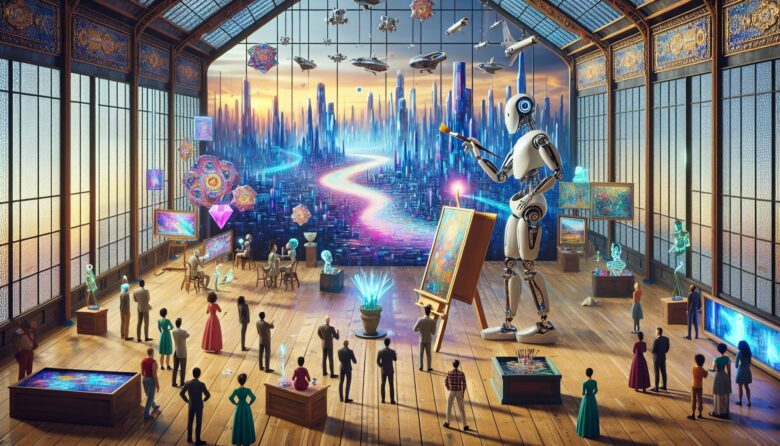
Alright, let’s get into it. I get that admitting you’re passionate about AI might sound like a nerd confession booth, but let’s face it—AI is doing some pretty cool stuff, particularly with creative arts. We’re not just talking about soulless code here; this is a new Renaissance. And I’m all in.
From Studio to Silicon: A Not-So-Typical Tuesday Evening
Picture this: it’s 7 PM, and you’re elbow-deep in some elaborate AI art project because, why not? That’s precisely how I spent last Tuesday. I was experimenting with one of those fancy AI image generators, and let me tell you—the results were incredible. It felt eerily similar to having Van Gogh as a silent partner, just without the chaos and ear issues.
The task was straightforward: input a few keywords and let the neural network paint a masterpiece. I typed in “Futuristic Cityscape at Sunset,” and in less time than it takes to decide on a Netflix show, there it was—an explosion of color and light that would make Blade Runner blush. I was now the proud creator, or at least the curator, of something uniquely captivating. If that’s not magical, I don’t know what is.
The Tech Behind the Brush
Before you start thinking this is some mystical tech wizardry, let’s break down the bits. These AI tools, like DALL-E and Midjourney, run on massive neural networks trained on endless datasets. It’s like feeding them billions of images so they can understand Van Gogh-style brushstrokes versus something you’d find in the MoMA.
But honestly, the real magic happens when these networks start to understand creativity. We’re not talking about tossing spaghetti at a wall and calling it art. The AI learns and adapts in ways that genuinely start to mimic human intuition, and sometimes, even improve upon it. Think of it like jazz improvisation, but with a lot of zeros and ones.
Why Artists and AI Are Best Buds Now
Some skeptics grimace at AI stepping into creative spaces, fearing it might push traditional artists out. But I see it differently. AI is a phenomenal tool, helping humans realize their wildest visions quicker and in some cases, more effectively.
Musicians are already jamming with AI to invent new soundscapes. Ever hear of the musician Holly Herndon? She’s been using AI to create humanly impossible vocal arrangements that are hauntingly beautiful. And this isn’t just a one-off. When you dig into the realms of art and music, you’ll find an ever-growing chorus of AI collaborators not looking to replace, but to amplify human creativity.
The Challenges & Skeptics: A Reality Check
Now, let’s not pretend everything is rainbows and unicorns. As with any tech, AI in creative arts has its hurdles. For starters, there’s the ethical mess—like who owns an AI-generated artwork? Is it the algorithm’s creator? The person who inputs the idea? The machine itself? Legal systems around the world are having a grand old time working this puzzle out, trust me.
There’s also the existential worry that we’re turning art into algorithms. Isn’t creativity more than just data points? The skeptics have a point; art is inherently human, driven by emotion, experience, and perception. Can a machine ever truly understand that? Probably not. But maybe, just maybe, that’s okay.
Into the Future: What’s On the Horizon?
Let’s indulge in some speculation. As AI continues to evolve, I predict it’s going to become an essential part of art schools. Just picture digital canvassing classes mixed with neural network understanding—sort of a “Tech x Picasso” hybrid curriculum.
More artists, possibly underground collectives, will start to use AI not as a tool, but as a legitimate band member. Imagine bands or art collectives touring with their AI partner, creating dynamic collaborations that adapt to audience reactions in real-time. It sounds a tad sci-fi, but hey, isn’t that where innovation shines brightest?
Conclusion: Embracing the AI Palette
So, there it is—AI in creative arts is no passing fad. It’s here, it’s mind-blowing, and it’s only going to get better. For me, this feels less like Techapocalypse and more like a celebration of human ingenuity mixed with machine learning. We’re on this creative journey together, dancing along the lines between tradition and technology.
So, grab your stylus, open your mind, and let’s see what we create next. After all, creativity didn’t die with the advent of photography or filmmaking; it transformed. AI is just the next leap. Let’s make sure we jump high.