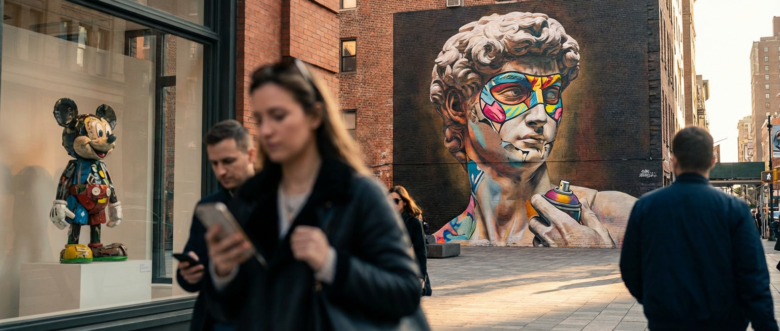
The Canvas as Cultural Battlefield
Walk into any contemporary gallery today and you’ll find yourself navigating a minefield of pop culture fragments reassembled into what curators breathlessly label “fine art.” Andy Warhol’s Campbell’s Soup Cans may have opened the floodgates in 1962, but what we’re seeing now goes way beyond simple appropriation. Contemporary artists aren’t just borrowing from mass culture. They’re completely rewiring how art gets made, turning the studio into a lab where high and low culture collide and create something entirely new.
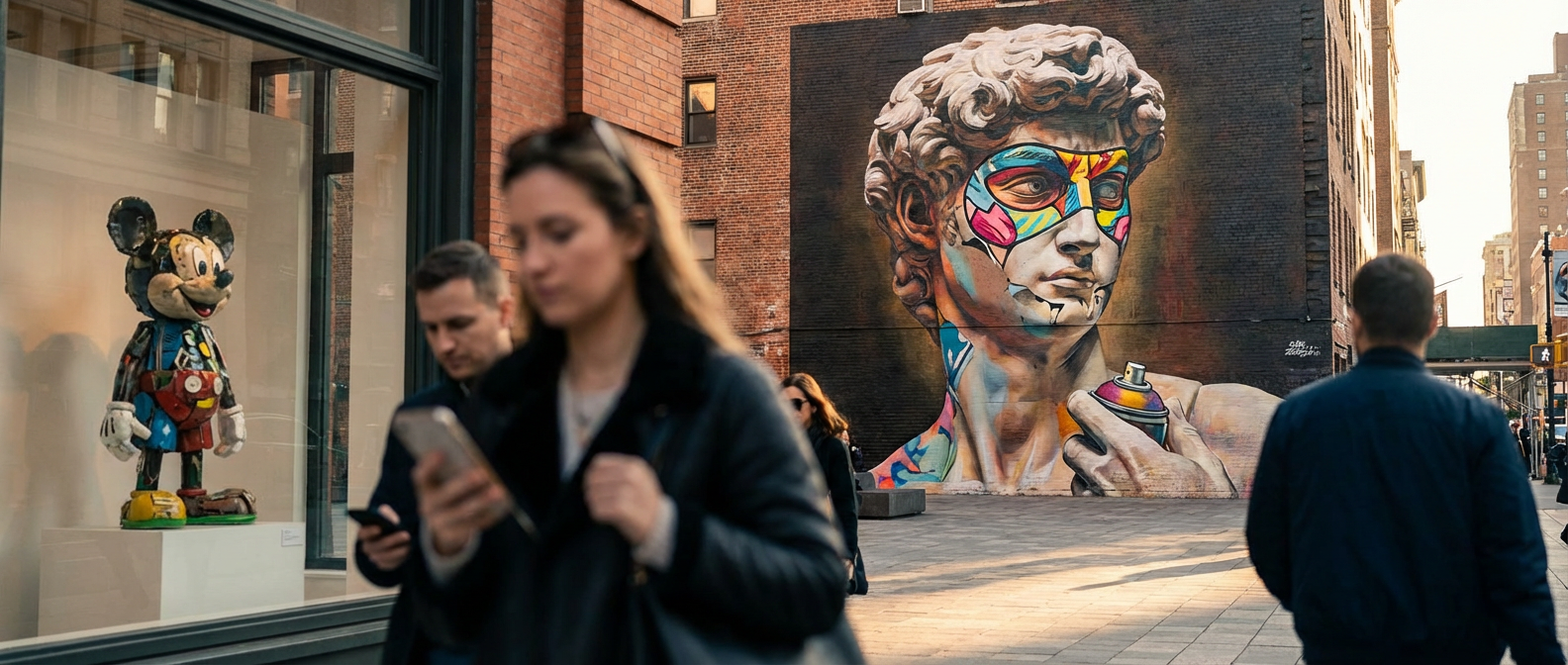
Take Kaws and his surgical dissection of cartoon characters. He literally takes apart Mickey Mouse ears, strips away their Disney DNA, and rebuilds them into monuments that speak to our collective childhood trauma. This isn’t some cute homage to cartoons. It’s archaeological surgery on the visual language we grew up with, turning innocent imagery into something that confronts our adult anxieties about authenticity and corporate manipulation.
The traditional fine art establishment still clutches its pearls over this invasion of the sacred temple, but they’re missing something huge. There’s a profound technical revolution happening in studios worldwide. When Takashi Murakami applies centuries-old Japanese painting techniques to anime-inspired flowers, he’s not trashing tradition. He’s expanding what it can do. The painstaking process of layering acrylic like ancient screen painters, combined with contemporary digital design principles, creates methods that simply didn’t exist before pop culture provided the bridge.
Digital Natives Redefining Materiality
Here’s what really gets me excited about this cultural cross-pollination: how digital-age artists approach physical materials. Artists like KAWS and Kehinde Wiley didn’t grow up making distinctions between “real” and “virtual” visual experiences. Their studio practices reflect this fluid relationship with media in ways that would blow the minds of earlier generations.
Wiley’s hyperdetailed oil paintings of young Black men positioned within ornate floral patterns from European decorative arts represent a technical tour de force. But the process is wild. He starts with street casting, photographing subjects in poses that reference canonical Western portraiture, then digitally composites these figures into elaborate backgrounds sampled from historical textile and wallpaper designs. The final paintings require months of careful brushwork to achieve photorealistic skin tones while simultaneously rendering fantastical botanical elements that could never exist in nature.
What critics often miss is the extraordinary technical demands this approach places on artists. Creating convincing oil paintings from digital composites requires understanding both traditional color theory and contemporary color management systems. Artists must master the translation between RGB color spaces and pigment mixing, between digital brushes and actual bristles loaded with paint. This isn’t about choosing old versus new. It’s about developing bilingual fluency that allows seamless movement between analog and digital worlds.
The Remix as Rigorous Practice
The concept of the remix, borrowed straight from hip-hop culture, has become maybe the most important methodological gift pop culture has given to contemporary fine art. But here’s the thing: unlike musical remixing, which primarily involves digital manipulation, visual remixing often demands an almost scholarly approach to art historical research combined with hands-on material experimentation that would make Renaissance masters weep with recognition.
Kerry James Marshall’s paintings offer a masterclass in this approach. His comic book-inspired aesthetic masks an incredibly sophisticated engagement with the entire Western painting tradition, from Byzantine icon painting to Abstract Expressionism. Marshall doesn’t simply reference these traditions. He methodically deconstructs their techniques and rebuilds them to serve his contemporary narrative purposes. His use of pure black pigment to render skin tones, for instance, requires mixing custom colors that maintain luminosity and dimension while rejecting the conventional brown-based palette traditionally used for Black subjects in Western art.
The technical challenge here is intense. You have to understand how different black pigments behave under various lighting conditions, how to maintain facial modeling without relying on traditional highlighting techniques, and how to integrate these figures convincingly into environments painted using more conventional color approaches. Marshall spends months testing pigment combinations and developing new mixing ratios to achieve effects that serve both his aesthetic vision and his political critique of art historical representation.
Installation as Pop Culture Archaeology
Where this fusion becomes most intellectually demanding is in large-scale installation work that treats pop culture artifacts as archaeological specimens requiring careful excavation and preservation. Artists like Theaster Gates and Thomas Hirschhorn have developed practices that involve literally collecting, cataloging, and reassembling fragments of popular culture into environments that function as both art galleries and research laboratories.
Gates’ process involves acquiring entire buildings, archives, and collections of materials that represent specific moments in African American cultural history, then methodically transforming these raw materials into immersive installations that preserve their historical significance while creating new contexts for understanding their contemporary relevance. His Stony Island Arts Bank project required developing expertise in architectural restoration, archival science, and community organizing alongside traditional sculptural skills.
The technical demands of such projects extend far beyond traditional art-making into areas like structural engineering, climate control systems for preserving fragile materials, and database management for tracking thousands of individual artifacts. These artists must become polymaths, developing specialized knowledge in multiple disciplines while maintaining the aesthetic sensitivity required to transform utilitarian preservation into transcendent artistic experience.
The Laboratory Method
What I find most compelling about examining these diverse practices is recognizing that pop culture’s influence on fine art extends far beyond surface-level imagery. We’re talking about fundamental questions of how art gets made in the twenty-first century. The studio has become a research facility where traditional craft knowledge intersects with digital fluency, where historical techniques get stress-tested against contemporary materials and concepts.
This evolution demands that we reconsider our assumptions about artistic authenticity and cultural value. The most compelling work being produced today doesn’t choose between high and low culture but develops new methodologies for synthesizing apparently incompatible approaches into something that transcends both. These artists aren’t abandoning craft tradition. They’re expanding its definition to include the technical demands of navigating an increasingly complex media landscape.
The real revolution isn’t happening in galleries or auction houses but in the quiet spaces where artists spend years developing new techniques for transforming cultural debris into objects worthy of sustained contemplation. Understanding this process requires abandoning the comfortable fiction that pop culture simply provides superficial content for serious artistic investigation. Instead, we need to recognize that it has completely altered the tools and methods available for making meaning through visual art.